Monday, June 30, 2014
Sunday, June 29, 2014
Answer to Case 309
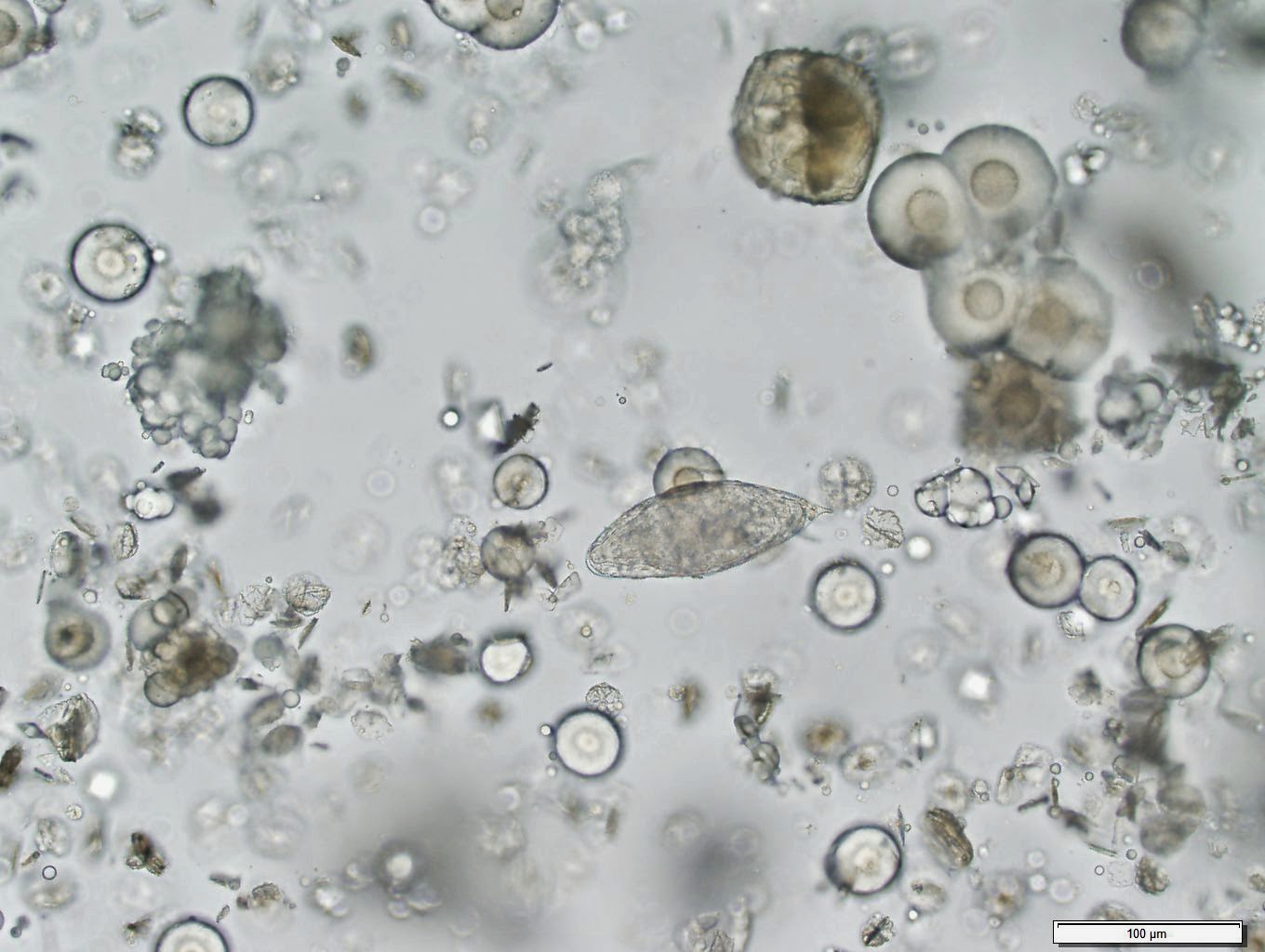
Answer: Schistosoma haematobium ova/eggs
Everyone who wrote in had the correct answer. These eggs have a very characteristic appearance with a large size (112 - 170 micrometers in length) and terminal spine. As mentioned by Hans, you can check to see if the eggs are still viable by looking for the internal beating flame cells, particularly in fresh specimens. Unfortunately this specimen was several days old by the time it had reached us (it had been sent in from another lab as a consult) and no motility was observed - possibly due to the age of the specimen. Hans also mentions that you can hatch the eggs - that's always something fun to do!
Anon noted the considerable debris that was present in the background. Indeed, one of the reasons I chose this case for a blog post is because it had a lot of crystals in the background which can make it challenging to spot the eggs. This is seen occasionally with refrigerated specimens; gently heating them will often dissolve the crystals and allow the urine to be examined for parasite eggs. Some types of urine crystals are commonly seen and do not necessarily indicate disease. However, other types of crystals are strongly associated with disease - particularly when persistent. When in doubt, consult your Clinical Chemist or suggest that a urine specimen be sent for crystal analysis.
Everyone who wrote in had the correct answer. These eggs have a very characteristic appearance with a large size (112 - 170 micrometers in length) and terminal spine. As mentioned by Hans, you can check to see if the eggs are still viable by looking for the internal beating flame cells, particularly in fresh specimens. Unfortunately this specimen was several days old by the time it had reached us (it had been sent in from another lab as a consult) and no motility was observed - possibly due to the age of the specimen. Hans also mentions that you can hatch the eggs - that's always something fun to do!
Anon noted the considerable debris that was present in the background. Indeed, one of the reasons I chose this case for a blog post is because it had a lot of crystals in the background which can make it challenging to spot the eggs. This is seen occasionally with refrigerated specimens; gently heating them will often dissolve the crystals and allow the urine to be examined for parasite eggs. Some types of urine crystals are commonly seen and do not necessarily indicate disease. However, other types of crystals are strongly associated with disease - particularly when persistent. When in doubt, consult your Clinical Chemist or suggest that a urine specimen be sent for crystal analysis.
Sunday, June 22, 2014
Case of the Week 308
The following case was generously donated by FloridaFan.
The patient is an 85 year old woman in a skilled nursing facility. She experienced a rash involving her scalp, and so scrapings were obtained and sent to the laboratory. Identification?
Saturday, June 21, 2014
Answer to Case 308
Answer: Demodex sp. and Sarcoptes scabei
This was a fun case because of the presence of 2 different mites in a single specimen. As noted by Arthur Morris, "it's likely that Sarcoptes is causing the rash, though in some cases Demodex can cause Sarcoptes-like rashes."
Mites belong to the class Arachnida, and therefore have 8 legs in the nymph and adult forms, but only 6 legs in the larval form, when they are newly emerged from the egg. Although it's a bit hard to make out in the photograph, I believe we have a larval Sarcoptes scabei mite in the bottom left of the image below, which helps explain its small size.
Thanks again to FloridaFan for donating this great case.
This was a fun case because of the presence of 2 different mites in a single specimen. As noted by Arthur Morris, "it's likely that Sarcoptes is causing the rash, though in some cases Demodex can cause Sarcoptes-like rashes."
Mites belong to the class Arachnida, and therefore have 8 legs in the nymph and adult forms, but only 6 legs in the larval form, when they are newly emerged from the egg. Although it's a bit hard to make out in the photograph, I believe we have a larval Sarcoptes scabei mite in the bottom left of the image below, which helps explain its small size.
Thanks again to FloridaFan for donating this great case.
Thursday, June 12, 2014
Case of the Week 307
Wednesday, June 11, 2014
Answer to Case 307
Answer: Fly larvae (maggots). You can tell that these are second instars because they only have 2 spiracular slits rather than 3. It is difficult to identify early instars to the genus level, given the lack of available literature. For the 3rd instar larvae, important identifying features include the mouth parts, posterior spiracles, body shape and arrangement of cuticular spines. You can often view the spiracles using only a stereomicroscope, although in this case, I cut off the posterior end and mounted it on a glass slide.
In this case, I can tell you that these are specifically blowfly larvae; Lucilia (Phaenicia) sericata; also sold as Medical Maggots (TM), since they were purchased by my institution. These maggots are actually cleared by the FDA for "debriding chronic wounds such as pressure ulcers, venous stasis ulcers, neuropathic foot ulcers and non-healing traumatic or post surgical wounds." Since they ingest only dead tissue, they offer a very effective means of wound debridement.
When ordered, they come in a small gauze, which is applied directly to the wound and then covered with a dressing. The instructions warn that after consuming the dead tissue, the maggots may migrate outside of the dressing, which can be a significant cause of consternation for the patient and nursing staff! Here is a link to some great information on maggot therapy.
In this case, I can tell you that these are specifically blowfly larvae; Lucilia (Phaenicia) sericata; also sold as Medical Maggots (TM), since they were purchased by my institution. These maggots are actually cleared by the FDA for "debriding chronic wounds such as pressure ulcers, venous stasis ulcers, neuropathic foot ulcers and non-healing traumatic or post surgical wounds." Since they ingest only dead tissue, they offer a very effective means of wound debridement.
When ordered, they come in a small gauze, which is applied directly to the wound and then covered with a dressing. The instructions warn that after consuming the dead tissue, the maggots may migrate outside of the dressing, which can be a significant cause of consternation for the patient and nursing staff! Here is a link to some great information on maggot therapy.
Sunday, June 1, 2014
Case of the Week 306
Saturday, May 31, 2014
Answer to Case 306
Answer: Trichuris trichiura (whipworm)
This was a tough case, as evidenced by the responses I received. Most of us are not taught the features of worms in histologic sections, but they not uncommonly pop up and pathologists and microbiologists alike are called upon to identify them.
In this case, the characteristic features of this nematode include variable diameter along the length of the organism, stichosome, bacillary band, annulated cuticle and nucleated hypodermis. A few of these features are highlighted in the images below. Thank you all for taking a chance on this one and writing in with your thoughts!
This was a tough case, as evidenced by the responses I received. Most of us are not taught the features of worms in histologic sections, but they not uncommonly pop up and pathologists and microbiologists alike are called upon to identify them.
In this case, the characteristic features of this nematode include variable diameter along the length of the organism, stichosome, bacillary band, annulated cuticle and nucleated hypodermis. A few of these features are highlighted in the images below. Thank you all for taking a chance on this one and writing in with your thoughts!
Monday, May 26, 2014
Case of the week 305
Multiple small worm-like objects were identified on endoscopic retrograde cholangiopancreatography (measuring approximately 5 mm - 8 mm in length) in a patient from Korea with recurrent right upper quadrant abdominal pain and a liver mass. One worm was removed and sent to the laboratory for identification, where it was stained (carmine stain) and mounted on a slide.
20x total magnification
100x total magnification
400x total magnification
1000x total magnification
20x total magnification
100x total magnification
400x total magnification
1000x total magnification
Sunday, May 25, 2014
Answer to Case 305
Answer: Clonorchis sinensis, the Chinese liver fluke.
As mentioned by Florida Fan and Tomáš Macháček, we can see several characteristic features of C. sinensis, including the oral sucker, esophagus, twin ceca, ova-filled uterus, lateral vitellaria, seminal receptacle and classic eggs with shouldered operculum (arrow heads). I've highlighted several of these features below:
The testes and other internal structures allow Clonorchis to be differentiated from the related fluke Opsithorchis. Clonorchiasis is usually acquired through ingestion of undercooked or raw fish and long standing disease may cause cholangiocarcinoma (possibly explaining the patient's liver mass in this case).
And now our poem from Blaine Mathison:
As mentioned by Florida Fan and Tomáš Macháček, we can see several characteristic features of C. sinensis, including the oral sucker, esophagus, twin ceca, ova-filled uterus, lateral vitellaria, seminal receptacle and classic eggs with shouldered operculum (arrow heads). I've highlighted several of these features below:
The testes and other internal structures allow Clonorchis to be differentiated from the related fluke Opsithorchis. Clonorchiasis is usually acquired through ingestion of undercooked or raw fish and long standing disease may cause cholangiocarcinoma (possibly explaining the patient's liver mass in this case).
And now our poem from Blaine Mathison:
When you see such small eggs
with an operculum
don't get caught up in a
parasitological conundrum!
the testes branching out like a
tree
supports a diagnosis of
Clonorchis, can't you see
as does travel to Korea, where
the patient hails from!
Subscribe to:
Posts (Atom)