Sunday, November 20, 2022

Answer to Case 702

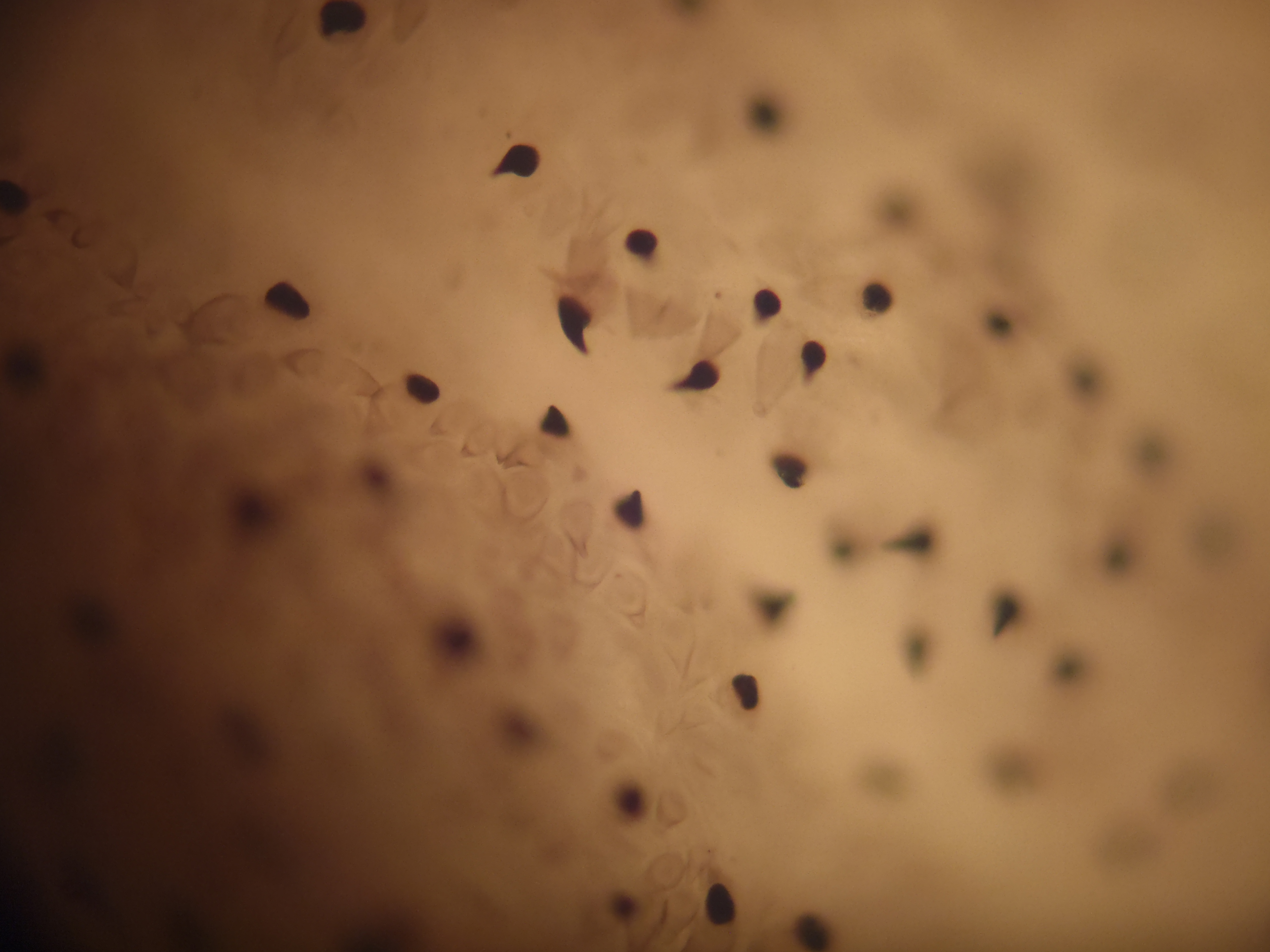
Answer to the Parasite Case of the Week 702: Demodex species; most likely D. brevis due to the short length of the posterior body (opisthosoma). As noted by Florida Fan, D. brevis inhabits the human sebaceous glands. This is in contrast to its lengthier neighbor, D. follicularis, which typically inhabits hair follicles. They are both primarily found in the face, including the eyelashes, eyebrows, and around the nose. Demodex spp. have 8 legs like other arachnids. The stubby legs end in blunt claws without pulvilli or suckers. Demodex mites also have short, blunt mouthparts and the body is elongated to a posterior point. Note that the mites do not have antennae; the structures seen below are artifacts from a neighboring air bubble. 


Demodex species are considered commensals in humans and do not usually cause disease. However, they have been associated with certain inflammatory conditions when present in large numbers, including folliculitis and rosacea. Therefore, they are worth reporting, but there is no need to urgently call the ordering provider with this finding. Thanks again to the Mycology lab for this beautiful photograph!

Tuesday, November 15, 2022

Case of the Week 701

 This week's case goes with some of my recent posts. The following arthropod was submitted from a patient with an itchy rash of his abdomen, pelvic region, and upper thighs. Identification? Also, are there any remarkable features of the particular parasite shown here?


Sunday, November 13, 2022

Answer to Case 701

Answer to the Parasite Case of the Week 701: Female Pthirus pubis, a.k.a, the 'crab' or 'pubic' louse. She is gravid - with 2 eggs! I've seen many female crab lice with eggs, but never one with two eggs at once, so when I came across this specimen, I immediately wanted to share it with you. An anonymous reader commented that "She's very likely to die prematurely from being egg bound, and will suffer from that full feeling."  I thought that was a very interesting (and rather witty) statement. Does anyone know if a female P. pubis with 2 eggs is less likely to survive?

Note that the pubic louse is shaped somewhat like a pelvis - a helpful feature for differentiating it from the head/body louse, which has a much longer body. The pelvis reference is useful since P. pubis is sexually-transmitted. It's also important to note that both the pubic and head/body louse have large raptorial (grasping) claws, but the pubic louse has larger claws on the second and third legs which, in combination with its body shape, make it look particularly crab-like.

As mentioned by Sam, we can tell that this is a female due to the morphology of the posterior end, whereas the male posterior end is more rounded. He also commented that "This louse causes genital crabs. The claws are designed to latch onto the course pubic hairs of the genital area, allowing sexual transmission of this ectoparasite."  Here is a side-by-side comparison of the 2 human lice (Pediculus humanus and Pthirus pubis) for comparison. Also check out Case of the Week 700 for a nice example (and my mascot!) of P. humanus.
Head/body louse (left) and pubic louse (right)

Thank you all for the excellent comments on this case!


Sunday, October 30, 2022

Case of the Week 700

 Dear Readers, I can't believe that I am celebrating my 700th post! In honor of this day, I am featuring the image that started it all - my 'mascot' of sorts. Can anyone tell me what this is? 


Saturday, October 29, 2022

Answer to Case 700

 Answer: Shown here is the head and front legs of Pediculus humanus, the human body/head louse. It's very hard to tell the gender from just the portion that I showed you, so here is an image of the complete body. As you can tell from the pointed posterior, this is a male rather than a female. Thanks to all who hazarded a guess!

Thank you all for the kind words of support for reaching this milestone as well. I couldn't do it without you. Your comments, contributed cases and support over the year continue to inspire me, and I always learn something from each case.

Tuesday, October 25, 2022

Case of the Week 699

Greetings from South Korea! This week's case shows an important parasite in this country, shown to be found in up to 8.4% of residents living along 5 major rivers in South Korea in a recent survey. What parasite is shown here? 


Bonus questions: what are the potential health implications for patients with long-standing infection with this parasite?

Sunday, October 23, 2022

Answer to Case 699

Answer: Clonorchis sinensis/Opisthorchis eggs. The location (South Korea) is consistent with C. sinensis.

As noted by Sam, "Both eggs have an abopercular knob and an obvious operculum. So these could be eggs of either Clonorchis sinensis or Opisthorchis species (both liver flukes). We can't differentiate based on morphology, but based on the patient being from/living in South Korea, we can likely narrow the identification down to Clonorchis sinensis, as Korea is an endemic region for this parasite. Whereas Opisthorichis viverrini is endemic to South East Asia (i.e, Vietnam, Cambodia, Laos, Thailand). Biliary complications can arise from long term Clonorchis sinensis infections, including cholangiocarcinoma."  Other complications, as noted by Eddy Martinez, are cholangitis, cholelithiasis, cholecystitis, and pancreatitis. The shouldered operculum and small size of the eggs (around 30 micrometers long) are nicely appreciated in this case:

The eggs of Metagonimus yokogawai and Heterophyes heterophyes also have a similar appearance and should be considered in the differential diagnosis. They are not found in South Korea, however, and can be excluded in this case.

Tuesday, October 11, 2022

Case of the Week 698

 This week's case is from Dr. Richard Bradbury and his colleague. The following "worms" were removed from the buttocks and left thigh of a 4 year old girl in The Gambia, West Africa. Identification?


Posterior spiracles:

Close up of the body:


Identification?

Sunday, October 9, 2022

Answer to Case 698

 Answer to Parasite Case of the Week 698: Cutaneous/furuncular myiasis due to Cordylobia anthropophaga (a.k.a. the tumbu or mango fly). As nicely described by Florida Fan, the spiny body, sinuous posterior slits without distinguishable peritreme, and the geographic location all are consistent with C. anthropophaga. Idzi P. added that "the evenly distributed and pigmented cuticular spines are also supportive of this identification." The presence of 3 slits indicates that this is a third stage larva, which allows for identification using commonly-available identification keys. 

Here is a closer view of the posterior spiracles, showing the characteristic posterior slits:

Cordylobia anthropophaga has a fascinating life cycle. The adult female fly lays 500-700 eggs at a time in dry soil contaminated with urine and feces. They have also been known to lay their eggs on clothing that are hung out to dry. Larvae hatch from the eggs and can remain alive in the environment for up to 2 weeks, residing just below the surface of the soil . When the soil is disturbed by a potential host, the larvae quickly emerge, and each can penetrate the skin of the host and create a cavity in which to live, feed, and mature. The posterior end of the larva faces outward within the resultant furuncle to allow for respiration through the posterior spiracles. Larvae go through 3 stages (referred to as L1, L2, L3) over a period of 8 or more days, and will then drop from the host and pupate in the environment. In warm climates, the adult fly hatches after 10-11 days.

I will always remember the story from a family member who went on a lavish African safari several decades ago and was somewhat embarrassed when the housekeeper insisted on ironing her undergarments after they had been hanging on the line to dry. When she told the housekeeper not to bother, she was very quickly informed why this was necessary - in very graphic detail! (You can see a rather disturbing case of furuncular myiasis of the breast HERE).

Thanks again to Dr. Richard Bradbury for donating this fascinating case.

Monday, October 3, 2022

Case of the Week 697

 It's time for our monthly case from Idzi Potters and the Institute of Tropical Medicine, Antwerp!

The following structure was seen in a lugol-stained wet preparation of concentrated feces.  

The corresponding iron hematoxylin stained fecal smear showed the following:

Identification?