Tuesday, January 30, 2024

Answer to Case 737

 Answer to the Parasite Case of the Week 737: Pentatrichomonas hominis trophozoites. 

P. hominis trophozoites have 5 flagella: 4 are directed anteriorly, while the 5th is directed posteriorly, forming the outer edge of an undulating membrane. This results in characteristic motility that Richard likes to describe as "a man trapped inside a plastic bag" (!)  I managed to capture a couple of still images from the video which show this phenomenon:


As noted by jebarner, P. hominis, as well as Enteromonas hominis,  Retortamonas intestinalis, and Chilomastix mesnili are non-pathogens and indicators of ingestion of fecally contaminated food or water. Therefore, the cause of this child's symptoms is unclear from this finding alone, and additional testing may be indicated.

Thanks again to Dr. Richard Bradbury for sharing this beautiful case!


Thursday, January 25, 2024

Case of the Week 736

The following arthropods were submitted to the lab for identification from a daycare center. What is your identification? What are the implications for this facility?


Wednesday, January 24, 2024

Answer to Case 736

Answer to the Parasite Case of the Week 736: Cimex sp., the human bedbug. Nymphs and an adult are present. The two species of Cimex that infest humans are C. lectularius (the common bedbug) and its tropical relative, C. hemipterus. As noted by Idzi and Florida Fan, the setae (hairs) are shorter than the width of the eye, which allows us to rule out other cimicids of birds and mammals that may temporarily infest human habitats.

Tanya Gravier provided a helpful link from the US Environmental Protection Agency on dealing with bedbug infestations in child care centers. As noted by Idzi, the risk is not with disease transmission, but rather with human bites at the center (e.g., during nap time), and with the possibility of bringing the infestation to the children's' homes.


Wednesday, January 17, 2024

Parasite Case of the Week 735

This week's case features a liver cyst (6 cm in diameter) that was removed and send to the parasitology laboratory for evaluation. The following images were taken by our fabulous Education Specialists, Felicity Norrie. Identification?


Tuesday, January 16, 2024

Answer to Case 735

 Answer to the Parasite Case of the Week 735: Echinococcus species.

The diagnosis can be made by the finding of the characteristic protoscoleces. As noted by Florida Fan, "On a closer look, the hooklets are clearly visible as well as the numerous calcareous particles. Since there is one cyst, the indication is that the agent is Echinococcus granulosis.

A Hamburg-based Oregon alumni further noted that for E. granulosus, "The liver is the most frequent location of echinococcal cysts (approx. 70% of cases). The lungs are the second most common location."

Thanks again to Felicity from my lab to taking these beautiful photos!


Wednesday, January 10, 2024

Case of the Week 734

Welcome to the first blog post of 2024! I had been particularly busy last year as I was serving as the Interim Chair of the Department of Laboratory Medicine and Pathology at Mayo Clinic. Now that the permanent Department Chair has arrived, I can go back to my 'day job' of Chair of Clinical Microbiology and Director of the Clinical Parasitology laboratory. I anticipate being able to go back to regular posting again as well. 

So without further ado, here is our case this week, courtesy of Heather Morris, the Parasitology Technical Specialist in my laboratory. The following objects were found in a concentrated wet preparation of stool, and measure approximately 20 micrometers in diameter. No patient history is available. What is your identification?


Tuesday, January 9, 2024

Answer to Case 734

 Answer to the Parasite Case of the Week 734: Entamoeba coli cysts. 

As noted by Florida Fan and Mary Lois Smorenburg noted, these cysts can be easily recognized by their large size and number of nuclei (>4). These are the most definitive features of this organism and allow it to be differentiated from similar-appearing Entamoeba spp. such as E. histolytica. Other supportive features pointed out by Mary Lois Smorenburg and Dr. Satishkumar Krishnan are the eccentric karyosome within each nucleus is and the irregular splinter shaped chromatoid body.

Thanks again to Heather Morris for donating our first case of 2024!


Thursday, December 7, 2023

Case of the Week 733

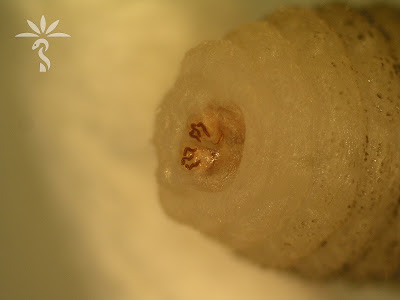
 This week's case is by Idzi Potters and the Institute of Tropical Medicine, Antwerp. The following object was removed from a furuncular skin lesion in a patient with recent travel to Uganda. Once they were able to keep it still (!), Idzi captured the following photographs demonstrating all of the diagnostic features. What is your identification?


Sunday, December 3, 2023

Answer to Case 733

 Answer to the Parasite Case of the Week 733: Cordylobia anthropophaga, myiasis causing fly larva. 

Florida Fan painted an accurate picture of this parasite with his vivid description: "The mango fly, aka Tumbu fly, lays eggs on human clothing hung to dry in the sun. The Man-Eating larvae hatching eats its way into the skin of its prey. The three sinuous slits are definite identification clues. Ironing the clothes dried outdoor kills the eggs and prevent a myasis infection. The video clearly exemplifies the voracious nature of The Beast." Very apt!

The adult female fly also commonly lays her eggs on sandy soil contaminated with urine and feces. The larvae hatch and may remain viable in the soil for 1-2 weeks while seeking a host. Upon contact with a suitable host, the larvae burrow into the skin of the host and develop for 8-12 days. They then emerge from the host and develop into pupae in the environment.

Extracted larvae can be identified based on the characteristics of their posterior spiracules, as well as their general body characteristics. There are several keys available for genus and species-level identification, including this older key from the CDC. Blaine Mathison and I also published a review on arthropod identification which you may find helpful. 

Along with this case, Idzi provided some great photos from previous posts for comparison:

Corydylobia rodhaina (Case of the Week 547):


Dermatobia hominis (Case of the Week 505):


Lastly, I'd encourage you to check out ITM's outstanding new podcast series entitled Transmission. Thanks again to Idzi and ITM for this great case!


Monday, November 27, 2023

Case of the Week 732

Welcome back to all of my US readers from the Thanksgiving holiday. Here is a fun case with the answer embedded - just listen to the audio with the video. Or if you'd prefer, keep the volume down and give your best guess on what you think this is! 

This case is donated by Dr. Jessica Lin and her colleague who is field physician in Tanzania.  The patient is a 4 year old boy with anal pruritus and history of passing worms from his anus. Several white-tan worms measuring ~5mm long were examined: