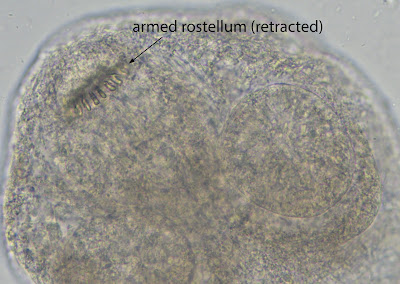
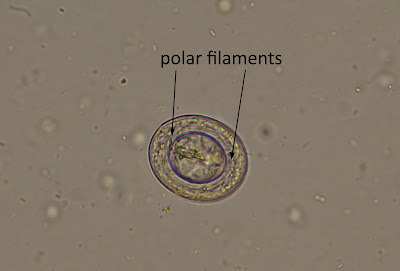
Answer to the Parasite Case of the Week 762: Enterobius vermicularis male
As noted by Idzi Potters, "The ribbed cephalic alae are typical for an Enterobius vermicularis adult. The curved tail and spicula (although retracted) point towards an adult male." These features can be easily appreciated in the below composite image. Thanks again to Felicity for the beautiful photographs!
Thanks also to all of those who wrote on Facebook, X (formerly Twitter), and LinkedIn with questions and comments. Some were intrigued that this worm was found on routine screening colonoscopy, which prompted me to count up the number of cases on my blog that had been discovered in this manner. It turns out that we multiple examples of adult nematodes and cestodes featured, including
Trichuris trichiura (Cases
73,
155,
306,
362,
405,
448,
490,
515,
598, and
631), hookworm/
Ancylostoma duodenale (Cases
520 and
759),
Taenia saginata (Case
353),
Rodentolepis (
Hymenolepis)
nana (
Cases 756,
664, and
169), and
Dipylidium caninum (Case
378). We also had a previous male
E. vermicularis on this blog detected during screening colonoscopy (Case
576). I wasn't aware that I had accumulated so many of these incidental cases over the years!
Others asked about the clinical significance of this finding. In this case, the patient was asymptomatic and there was likely no clinical relevance. This is not surprising, as enterobiasis is frequently asymptomatic,. However, it is likely that this patient was treated to eliminate the chance of him serving as a reservoir for infection.