Here is our last case of 2024, courtesy of Drs. Courtney Comar and Laura Lamps. The following structures were seen in tissue removed during surgery from the peritoneal cavity of a patient with volvulus of the bowel and associated inflammatory changes. On histopathology, numerous foreign body giant cells and 'pulse granulomas' were seen. What are these structures?
Monday, December 30, 2024


Sunday, December 29, 2024
Answer to Case 764
Answer to the Parasite Case of the Week 764: Artifact; not a human parasite. This material closely resembles plant spirals. This was a challenging case to be sure! However, there were a few clues that can help us out here:
First, note that the outer contour of these worm-like objects consists of spiral, refractile rings that look a bit like a 'slinky' (for those of you who remember those old toys!)

Second, I mentioned that numerous foreign body giant cells and 'pulse granulomas' were seen on histopathology. Pulse granulomas are granulomas associated with a foreign-body reaction and often contain identifiable vegetable material. The term 'pulse' refers to the edible seeds of leguminous vegetables. The presence of vegetable material elsewhere in this specimen support our diagnosis of vegetable spirals here.
For further confirmation, I turned to our friend and botany expert, Dr. Mary Parker, for her advice on this case. She indicated that we are likely seeing xylem vessels with spiral thickenings from plant vascular bundles (veins). She noted that "the simple spiral thickening in the above is typical of plant material such as young leaves (i.e. not as heavily thickened as in woody material), whereas the xylem thickenings in the colon wall are much more heavily lignified, indicating more mature plant material." She also explained that "young leaves like spinach, lettuce and parsley will all have a mixture of lightly and more-heavily thickened xylem." I remember learning about xylem and phloem back in primary school, but I never thought they would be useful in parasitology. Many thanks to Mary for her input, and kudos to Idzi for getting this case correct!
Check out the beautiful xylem spirals from this POST.
Wishing you all a very happy, healthy, peaceful, and productive new year.
Monday, December 16, 2024
Case of the Week 763
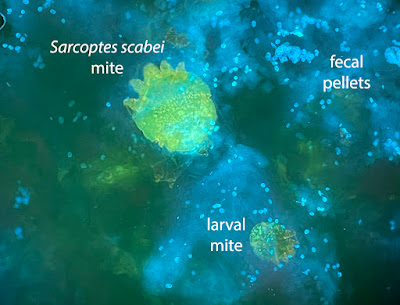
This week's case was donated by Dr. Andrew Bryan, Molly Weatherholt, Clarissa Ljungren, Bashi Ebrahimi, and Jacob Karsten. These striking images are from skin scrapings from an elderly patient with suspected superficial cutaneous fungal infection. The material was stained with Calcofluor white and examined with fluorescence microscopy. Diagnosis? What are the objects seen here - the big and little ones?


Sunday, December 15, 2024
Answer to Case 763
Answer to the Parasite Case of the Week 763: Sarcoptes scabei mites and their scybala (fecal pellets) - or, as Mike M. said - "scabies, and a lot of their poop!"
As Idzi noted, "...the small stuff on the 2nd image has the right size and the typical “puck”-shape with a dent, to be compatible with mite-droppings." However, Florida Fan also mentioned that we need to rule out small yeasts such as Malassezia spp. since they could also be present in the same slide - a great reminder!
In case you were wondering what scabies eggs looks like, here is a case that Florida Fan donated to the blog years ago:


Thanks again to Dr. Andrew Bryan, Molly Weatherholt, Clarissa Ljungren, Bashi Ebrahimi, and Jacob Karsten for donating this great case.
Tuesday, December 3, 2024
Case of the Week 762
This week's case comes from my own lab - an unexpected finding on routine colonoscopy. These beautiful photos are courtesy of Felicity Norrie. Identification?


Sunday, December 1, 2024
Answer to Case 762
Answer to the Parasite Case of the Week 762: Enterobius vermicularis male
As noted by Idzi Potters, "The ribbed cephalic alae are typical for an Enterobius vermicularis adult. The curved tail and spicula (although retracted) point towards an adult male." These features can be easily appreciated in the below composite image. Thanks again to Felicity for the beautiful photographs!

Others asked about the clinical significance of this finding. In this case, the patient was asymptomatic and there was likely no clinical relevance. This is not surprising, as enterobiasis is frequently asymptomatic,. However, it is likely that this patient was treated to eliminate the chance of him serving as a reservoir for infection.
Monday, November 18, 2024
Case of the Week 761
This week's case was generously donated by Drs. Taylor Williams and Karl Kirby. The following object was passed per rectum by a child living in the Western US without travel outside of the country. The family also does not report any international travel. What is your differential diagnosis?
.jpg)
.jpg)
.jpg)
Sunday, November 17, 2024
Answer to Case 761
Answer to the Parasite Case of the Week 761: Diphyllobothrium/Dibothriocephalus/Adenocephalus (diphyllobothriid) species. These worms are commonly referred to as the broad fish tapeworm based on the fact that their proglottids are broader than they are tall and they are acquired through eating undercooked fish. The diphyllobothriid tapeworms have a very characteristic 'rosette-shaped' central uterus which we can see here:
_answer.jpg)
This picture also nicely shows the craspedote nature of the proglottids, characteristic of the diphyllobothriid tapeworms. The term craspedote refers to the overlapping arrangement of the proglottids - like shingles or tiles. This feature, along with the uterine structure, is helpful in differentiated the diphyllobothriid tapeworms from Taenia species.
Thanks again to Dr. Taylor Williams and Karl Kirby for donating this highly educational case.
Monday, November 11, 2024
Case of the Week 760
This week's case was generously donated by Dr. Adrienne Showler. The patient is an immunocompromised middle-aged man from El Salvador who presented with vomiting, diarrhea, and weight loss. The following are hematoxylin and eosin-stained images of the duodenal biopsy. What is your diagnosis? What are the structures shown?
%5B64%5D.jpg)
%5B99%5D.jpg)
Sunday, November 10, 2024
Answer to Case 760
Answer to the Parasite Case of the Week 760: Strongyloides stercoralis larvae, eggs, and an adult female in the small intestine. This is an important finding as the patient might be at risk for life-threatening hyperinfection syndrome. Some eggs are unembryonated, whereas others have matured and contain larvae.
%5B99%5D.jpg)
The differential diagnosis of adult nematodes, larvae, and eggs within the intestinal mucosa is limited. Capillaria (=Paracapillaria) philippinensis can have a similar appearance, but Capillaria eggs have a striated wall and bipolar plugs which allow for their differentiation from the thin-walled eggs of S. stercoralis. Also, both male and females are present in C. philippinensis, whereas only females are seen in S. stercoralis infection.
Thanks again to Dr. Showler for donating this great teaching case!
Subscribe to:
Posts (Atom)